
Psittacula eupatria & Psittacula krameri: the fivefold SL ino (Lutino) mystery

Psittacula eupatria & Psittacula krameri: the fivefold SL ino (Lutino) mystery

24/03/2026

Five genetically distinguishable SL ino mutations. One identical Lutino phenotype. How NeorniLab tells them apart with DNA analysis.

Not all yellow is the same.

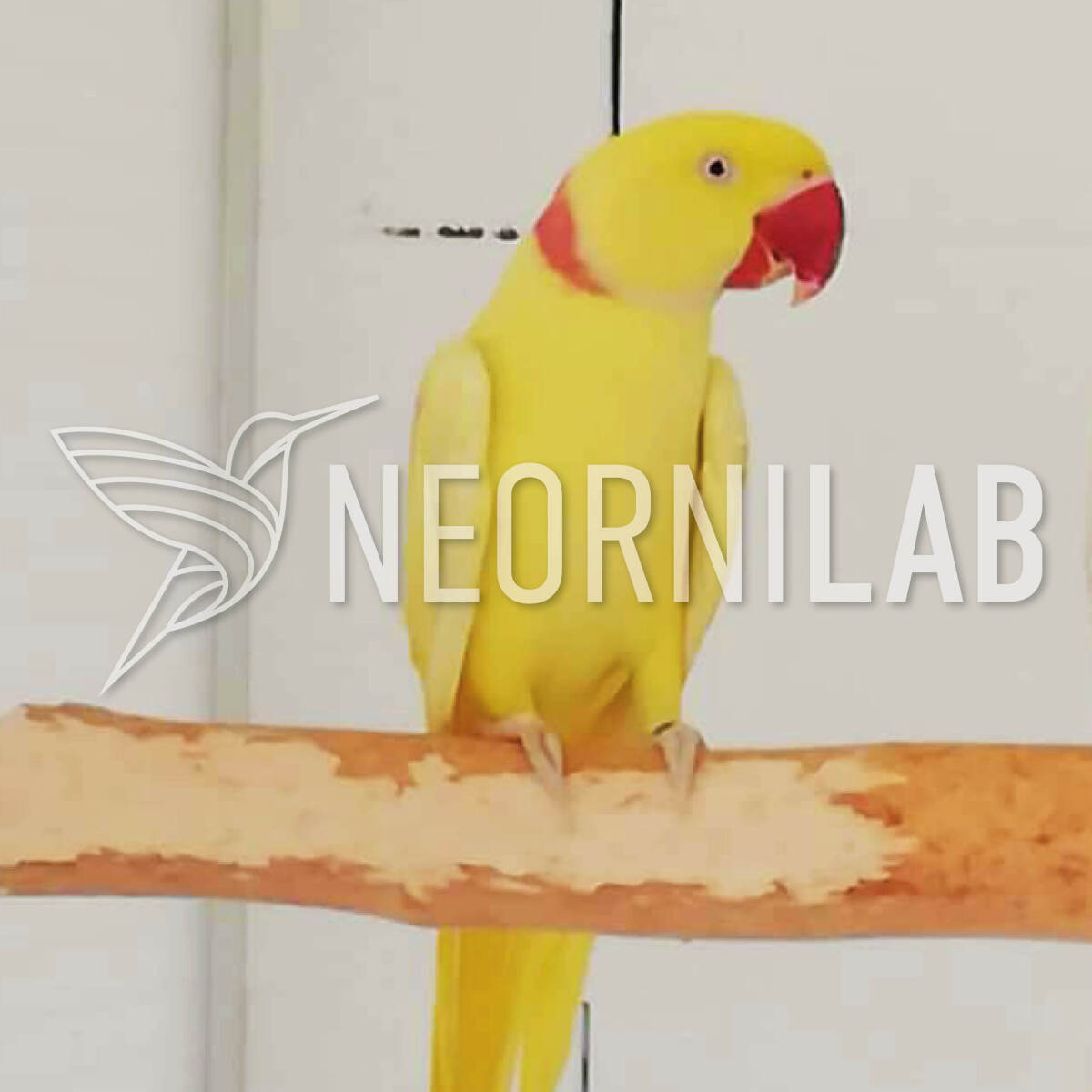
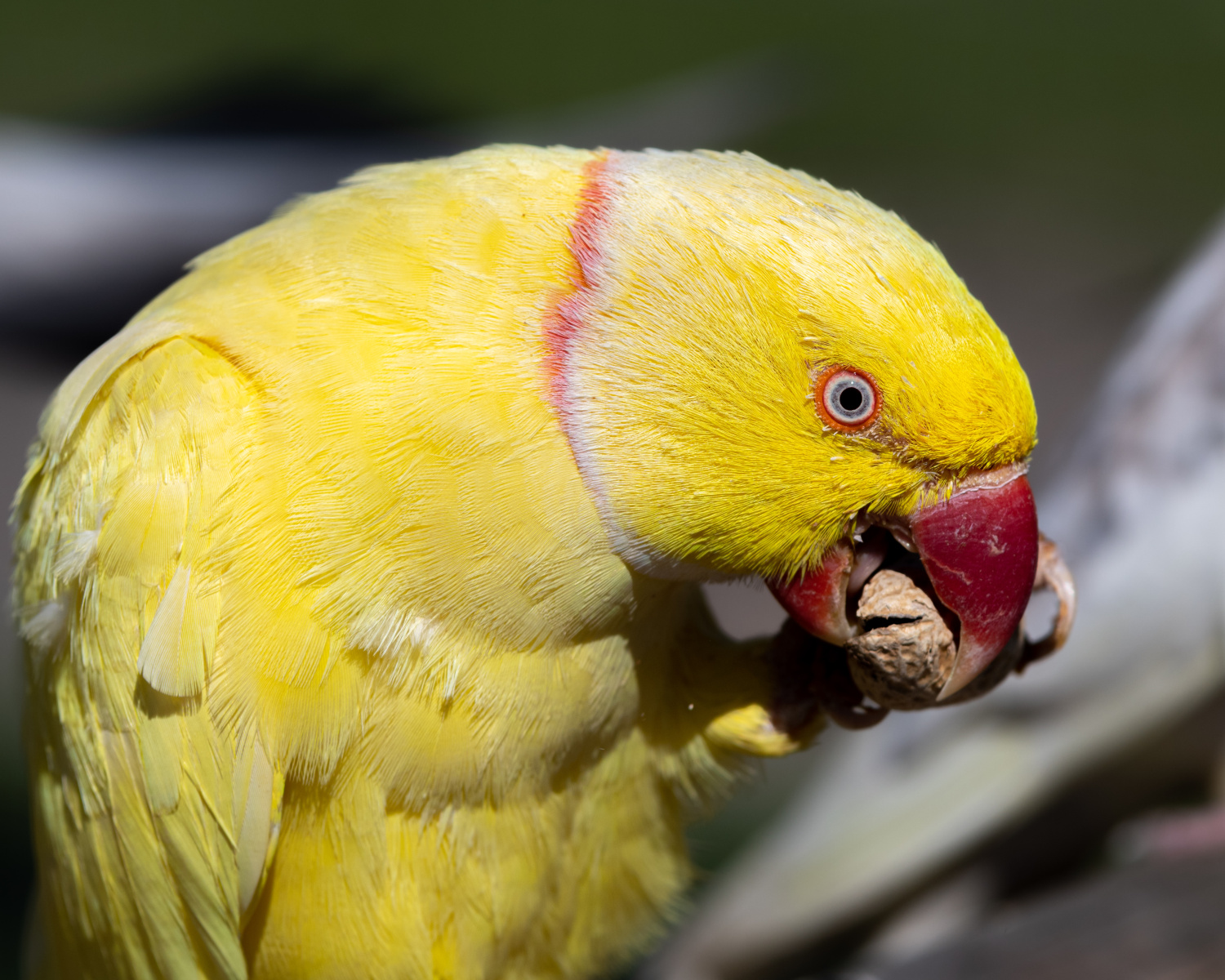
All lutinos look alike. Pale yellow plumage, red eyes, yellow flight feathers. Yet their genes tell a different story.

In the Alexandrine Parakeet (Psittacula eupatria) and the Rose-ringed Parakeet (Psittacula krameri) we have, to date, mapped five genetically distinguishable SL ino mutations, each at a different position in the same gene, and each with its own story. Visually one picture, genetically five.

How many lutino mutations exist in the Alexandrine and Rose-ringed Parakeet?

A lutino arises because an enzyme that produces eumelanin (the dark pigment) is disrupted, while the psittacofulvin (the yellow-red pigment) remains intact. The result is visually identical across all five SL ino mutations: a yellow bird with red eyes. Genetically, by contrast, they are five independent genotypic variants, each at a different position in the gene. Only a DNA analysis can tell them apart.

Inheritance

All five SL ino mutations are inherited sex-linked recessive. The "SL" in the name refers to sex-linked: the mutation sits on the Z sex chromosome.

In birds, the sex-chromosome pattern is the reverse of mammals:

  • Males are ZZ. They need two copies of the mutation to be phenotypically lutino. A male carrying only one copy is split (a carrier without outward expression).
  • Females cannot be split for SL ino mutations. They have only one Z chromosome and therefore automatically carry just one copy of an SL ino mutation. As a result they are either lutino or completely free of it. This also applies to other sex-linked mutations.
    The five SL ino mutations at a glance

    We number the ino mutations in the Psittacula eupatria and the Psittacula krameri continuously, in order of discovery and because the two species have become genetically strongly intertwined. All five mutations, when homozygous, produce the classic lutino phenotype.

    • SL ino1. This genotypic variation we have so far picked up only in the Psittacula eupatria. Some breeders consider SL ino1 the only "true eupatria ino". Genetically we cannot substantiate that; we can only say that we have to date established SL ino1 exclusively in this species.
    • SL ino2. Occurs in both the Psittacula eupatria and the Psittacula krameri, at exactly the same position in the gene. That cannot be coincidence. We come back to it at length in our blog post on species purity.
    • SL ino3. So far we have found this mutation only in the Psittacula krameri. Should SL ino3 ever turn up in a Psittacula eupatria, that may point to crossing-in. With the current data, however, we cannot fully rule out that the mutation also arose spontaneously in the Psittacula eupatria.
    • SL ino4. Likewise found only in the Psittacula krameri so far. Same caveat as for SL ino3.
    • SL ino5. A new genotypic variant that we are currently working out further. Identified in an Italian bloodline, to date only in the Psittacula eupatria. Confirmation will follow soon.

    Curious which DNA is present in your bloodline?

    Request a targeted DNA analysis and find out everything about your bird's DNA.

    Compound heterozygotes: what do we expect?

    The position of each mutation in the gene and the predicted effect on the protein allow us to state with certainty that every allelic compound heterozygous combination (for example SL ino1 / SL ino2) also produces the lutino phenotype in a male bird. In practice we have not yet tested any compound heterozygous birds, but that does not change the prediction: each of the five mutations produces a lutino when homozygous, so a combination of two different SL ino mutations will, genetically, also yield a lutino.

    For you as a breeder, phenotypically this changes little: the bird is and remains a lutino. Genetically, however, it does give an indication. A male that turns out to have the genotype SL ino1 / SL ino3, for example, is an indirect signal of crossing-in between the two species. This may have happened in captivity or in the wild. It is not conclusive proof, because a mutation can in theory also arise independently, although that chance is particularly small. It does remain a strong indication

    Inheritance: a few examples of pairings

    SL ino is inherited sex-linked recessive. A few common pairing scenarios:

    PairingMalesFemales
    Split male × wildtype female50% split, 50% wild type50% lutino, 50% wild type
    Lutino male × wildtype female100% split100% lutino
    Split male × lutino female50% split, 50% lutino50% lutino, 50% wild type
    Lutino male × lutino female100% lutino100% lutino

    What this gives you as a breeder

    A targeted SL ino screening puts your breeding planning on solid ground. In concrete terms:

    • You test only what is relevant for your bloodline. Know which of the five SL ino variants occurs in your birds, without unnecessary analyses for mutations that are not present.
    • You put pairs together with a predictable result. Because SL ino is inherited sex-linked, you can estimate in advance how many lutino males and lutino females a pair will produce. That saves time as well as unnecessary splits in your aviary.
    • You prevent inbreeding. By knowing which birds are possibly split, you can out-cross deliberately to wild-colour birds. This keeps genetic diversity in your bloodline without losing the desired colour varieties.
    • You get an indication of your bloodline's ancestry. An unexpected SL ino variant points to possible crossing-in between the Psittacula eupatria and the Psittacula krameri. You can read more context on this in our blog post on species purity.
    • You give your buyers certainty. Every tested bird receives a unique NeorniLab certificate that you pass on at the point of sale. Buyers can verify the certificate at purchase via our certificate checker.

    For your information

    For our SL ino5 study, our researchers are currently finalising the last confirmation. No additional samples are needed for this.

    Curious about other mutations in the Alexandrine Parakeet? Then also read our blog post on the blue series.

    Curious about your bird's DNA?

    Contact us