
CRY1
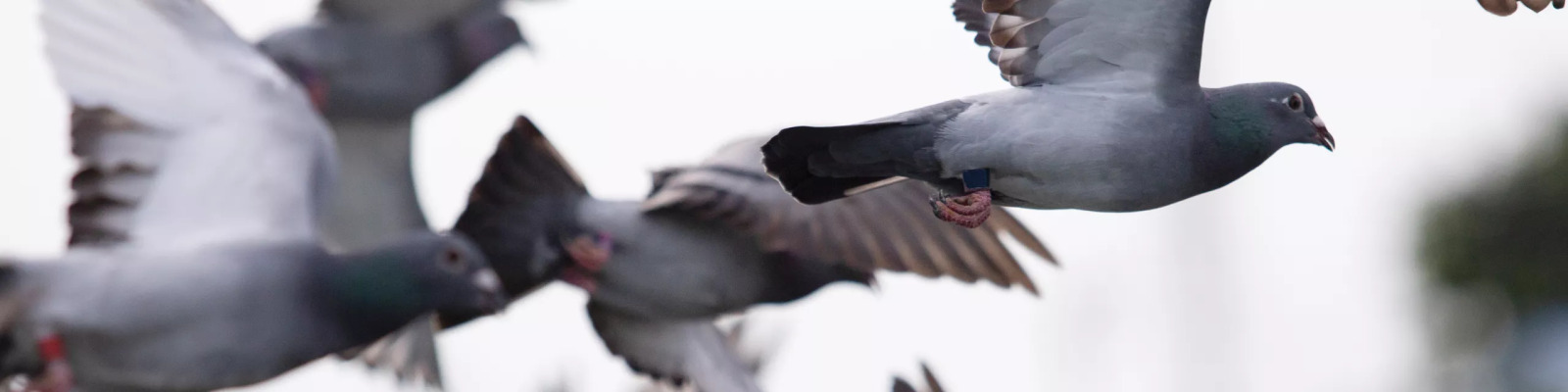
The cryptochrome-1 gene (CRY1) appears to be a very important factor for good flight performance in pigeons. In other birds, it was already clear that the sense of the earth's magnetic field, which helps with orientation, is linked to certain proteins in the eye. In pigeons too, there is now some evidence suggesting that cryptochromes also play a role in sensing the Earth's magnetic field, which helps them navigate while flying. These specific proteins, called cryptochromes, act as a kind of magnetic sensor. They are also involved in regulating circadian rhythms (the internal "clock") for distinguishing day and night and perceiving UV light. CRY1 is a dinucleotide polymorphism at the level of an intron, in which 2 nucleotides differ simultaneously when mutated. Such a change in an intron can affect how often the gene is used to make the protein. This is called gene expression.
Within the CRY1 gene of pigeons, 2 variants or alleles, AG and TT, were initially identified and studied. This showed that pigeons with the CRY1AG/TT genotype achieved significantly better results. Later, however, a 3rd variant or allele (AT) was discovered through thorough research within NeorniLab. More research is needed to fully understand this AT variant.
Suitable samples
Feathers
- 4–5 freshly plucked breast feathers
- Moulted feathers, down feathers, and blood feathers should be avoided. These sometimes contain insufficient DNA or can cause damage to the feather follicle when pulled out. Blood feathers are new feathers that can be recognized by the blue sheath at the base of the feather.
- To avoid contamination, do not touch the shaft (the end of the feather protruding from the bird’s skin) with your hands.
Blood sample
- Small amounts (capillary tube) are sufficient for an accurate analysis.
- A drop of blood on a coffee filter or paper.
Cheek swab from a nestling
A gentle way to collect DNA from young birds
Note: avoid contamination with food or food scraps
Eggshell with membrane
Have you recently had a nest hatch? If so, save the eggshells. Place the shell, with the dried blood vessels still attached, as completely as possible into a plastic zip-top bag and send it to us.
Turnaround times
- If you send the sample by mail, we will confirm receipt via email.
- Processing time: 5-7 business days from receipt of your sample.
- You will receive an email when your results and certificate are available on your personal portal.
Prices
| Performance genes | Excl. VAT (€) / price per item |
|---|---|
| 1 genotype | € 36,00 |
| 2 genotypes | € 39,00 |
| 3 genotypes | € 42,00 |
| 4 genotypes | € 45,00 |
| 5 genotypes | € 48,00 |
| 6 genotypes | € 51,00 |
| 7 genotypes | € 54,00 |
| 8 genotypes | € 57,00 |
Request a test
STEP 1: Complete the request form
Choose whichever way of filling it in suits you best.
- Excel: fill in digitally.
- PDF: print and fill in by hand.
Then add it to the form below, or send it along with your samples.
STEP 2: Send us your samples
There are several ways to do this
- At our front desk* (during opening hours)
- Through the letterbox* (outside opening hours)
- By post*
- Through your vet
STEP 3: Payment & results
You will receive your invoice as soon as we have received your complete request.
Payment can be made on site*, by bank transfer or through your vet. Once payment is received, we begin the analysis.
You will receive your certified results by email, within the agreed turnaround time, unless stated otherwise.
* Our address: NeorniLab, Beverlosesteenweg 129, 3583 Paal, Belgium